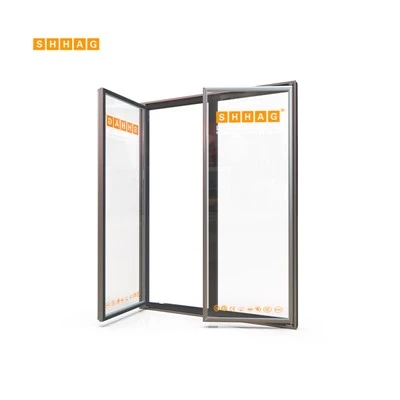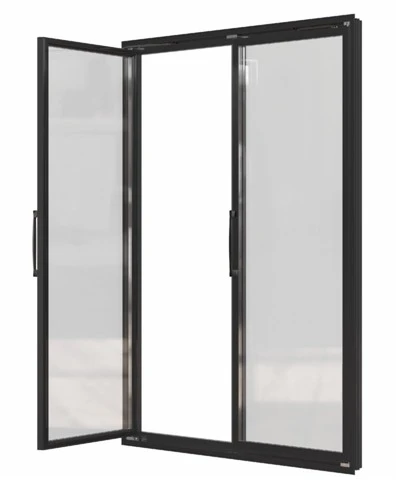
The key to judging the quality of a glass door lies in five core dimensions: glass material, frame craftsmanship, hardware accessories, sealing treatment, and overall installation precision. Each of these directly affects its safety, durability, and user experience.
1. Examine the Glass: Safety and Transparency are Fundamental
Is it Tempered Glass? High-quality glass doors must use tempered glass (compliant with national 3C certification). When broken, it forms small, harmless granules. This can be confirmed by checking the 3C mark on the corner of the glass or by professional testing.
Thickness Meets Standards: For residential glass doors, 8–12mm is recommended. Too thin and it's easily broken; too thick and it increases the load-bearing capacity. For commercial spaces, 12mm or more is recommended.
Surface Quality: When viewed from the side, the glass should be flat, without ripples, bubbles, scratches, or haze to avoid visual distortion.
Special Function Glass: For privacy, frosted, fluted, or wired glass are available; for heat insulation and soundproofing, insulated or laminated glass is recommended.
2. Check the Frame: Material and Structure Determine Stability
Material Selection: Prioritize aluminum alloy or stainless steel frames, avoiding inferior recycled aluminum or wood frames (prone to deformation and moisture).
Wall Thickness Standard: Frame wall thickness should be no less than 1.2mm, with high-quality products reaching 1.5–2.0mm, ensuring load-bearing capacity and wind pressure resistance.
Surface Treatment: High-quality frames have a smooth surface, uniform color, no burrs, and no oxidation peeling. They use anodizing or electrophoretic coating, offering strong corrosion resistance.
Structural Design: Check if the frame has a multi-cavity structure, providing heat insulation and drainage functions, which is superior to single-cavity profiles.
3. Check the Hardware: The Core Factor Determining Lifespan
Hinges: Stainless steel should be used, with strong load-bearing capacity (recommended ≥50kg), and smooth opening and closing without abnormal noise. Refer to standard JG/T326-2011; the number of repeated opening and closing cycles should be over 200,000, with high-end products reaching 500,000 cycles.
Sliding System: Sliding doors should preferably use a hanging track + double pulley design for smoother operation, no floor protrusions, and easy cleaning. The pulleys should be made of nylon + stainless steel bearings, quiet and wear-resistant.
Locks and Door Closers: Check if the locking points are secure, if the closing force of the door closer is adjustable, and if the closing time is between 6-10 seconds to avoid pinching fingers or failure to close automatically.